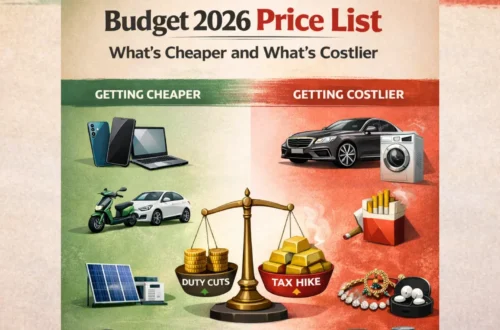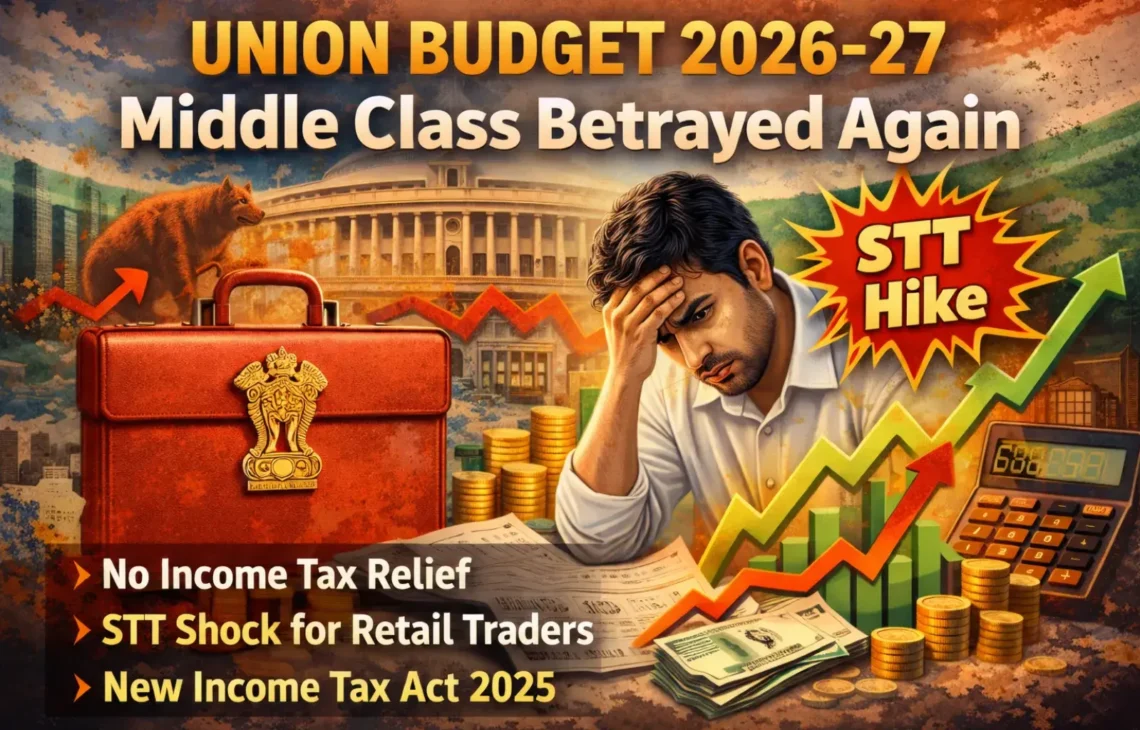
The Union Budget 2026-27, presented by FM Nirmala Sitharaman, is a high-stakes “Infrastructure First” manifesto that doubles down on long-term growth with a record ₹12.2 lakh crore capital expenditure. However, it has sparked immediate controversy by offering no changes to income tax slabs, hitting retail traders with a hefty STT hike on F&O, and introducing a completely new Income Tax Act, 2025 aimed at structural overhaul rather than immediate middle-class relief.
Union Budget 2026-27: Another Blow to the Middle Class?
February 1, 2026 – As Finance Minister Nirmala Sitharaman concluded her ninth consecutive budget speech today, a familiar and bitter taste lingered for millions of Indians: disappointment. While the government lauded the Union Budget 2026-27 as a “roadmap to Viksit Bharat,” a closer look reveals a document that, once again, seems to have sidestepped the urgent cries of the common man, leaving many to wonder if they’ve been forgotten in the grand economic narrative.
The much-anticipated budget, presented on a Sunday, was framed around three “Kartavyas”—Sustaining Growth, Fulfilling Aspirations, and Sabka Vikas. Yet, for those battling inflation, stagnant wages, and rising living costs, these lofty promises feel hollow when stacked against the harsh realities.
The STT Shock: A Direct Hit to Small Investors
Perhaps the most immediately painful announcement was the unexpected hike in Securities Transaction Tax (STT) on Futures and Options (F&O). This isn’t just a tweak; it’s a direct blow to the burgeoning class of retail investors who have flocked to the markets seeking to build wealth. In a move that seems designed to discourage participation, the government has effectively made it more expensive for ordinary Indians to trade, potentially pushing them out of a crucial avenue for financial growth. It’s a clear signal: the small investor, often seen as a volatile element, is now paying the price.
You May Read Also: Why Gold and Silver Prices Are Soaring: An Expert’s Perspective
Income Tax Act 2025: A New Name, Same Old Burden?
While a new Income Tax Act, 2025 was announced, the biggest letdown was the glaring omission of any relief on income tax slabs or rates. For a populace grappling with persistent inflation eroding their purchasing power, the hope for higher tax-free income or reduced rates was palpable. Instead, they got a new act, promising “simplified compliance” – a phrase often met with skepticism by those who simply want more money in their pockets, not just easier paperwork. It feels like rearranging deck chairs on a sinking ship for the salaried class.
Big Infrastructure, Small Relief:
Yes, the capital expenditure has soared to a record ₹12.2 lakh crore, with ambitious plans for seven new high-speed rail corridors and extensive infrastructure projects. But for the average family struggling to make ends meet, how does a new bullet train corridor translate into tangible benefits today? While long-term growth is crucial, the immediate concerns of food prices, fuel costs, and education expenses remain unaddressed. It’s a budget that prioritizes steel and concrete over the daily anxieties of its citizens.
Healthcare & Education: Promises, Not Palliatives
While the waiver of customs duty on 17 cancer drugs and exemptions for other rare diseases are welcome, they are small comforts in a system that still struggles with accessibility and affordability for routine care. Similarly, the focus on university townships and girls’ hostels, while noble, feels distant when basic public healthcare and primary education infrastructure remain under strain. The budget talks about “skilling,” but for whom, and at what cost?
A Budget for the Elite, Not the Everyman?
The narrative emerging from Union Budget 2026-27 is one of a government focused on grand economic ambitions and big industry, potentially at the expense of the everyday Indian. The “Kartavyas” might sound good on paper, but for those facing economic headwinds, this budget feels less like a guiding light and more like a missed opportunity – leaving the middle class to shoulder the burden, yet again, without much to show for it.
Union Budget 2026-27: The 10-Point “Cheat Sheet”
If you only have a minute, here are the critical changes that will impact your wallet and the economy this year:
- Income Tax Freeze: No changes to existing income tax slabs or rates. The status quo remains for the salaried class.
- The New Tax Era: A completely new Income Tax Act, 2025 was introduced (effective April 1, 2026) to simplify rules and reduce legal disputes.
- STT Shock for Traders: Securities Transaction Tax (STT) on Futures hiked to 0.05% and Options to 0.15%, causing a sharp stir in the stock markets.
- Record Capex: Infrastructure spending hit a massive ₹12.2 lakh crore, focusing on 7 new high-speed rail corridors and a new East-West freight corridor.
- Cheaper Lifeline Meds: Customs duty waived on 17 cancer drugs and 7 rare disease medicines, providing major relief to patients.
- SME Growth Fund: A new ₹10,000 crore fund was launched to help small businesses scale up and become “Future Champions.”
- Tech & Chips: “Semiconductor Mission 2.0” launched with a ₹40,000 crore outlay to make India a global hub for chip design.
- The “Orange Economy”: A huge push for content creators with AVGC (Animation, Visual Effects, Gaming) labs coming to 15,000 schools.
- Rare Earth Corridors: Four states (Odisha, Kerala, Andhra, Tamil Nadu) will get dedicated corridors to mine minerals essential for EV batteries.
- Education & Gender: Commitment to build five University Townships and one girls’ hostel in every single district for STEM students.
Frequently Asked Questions About Union Budget 2026-27
Q1: What is the biggest takeaway from Union Budget 2026-27?
A: The biggest takeaways include a record capital expenditure hike, the introduction of the new Income Tax Act, 2025, and significant increases in Securities Transaction Tax (STT) for F&O. Many also highlight the lack of direct income tax relief for the middle class.
Q2: Were there any changes to income tax slabs or rates in Budget 2026?
A: No, the Union Budget 2026-27 did not announce any changes to the existing income tax slabs or rates for individuals. However, a new Income Tax Act, 2025, was introduced.
Q3: How does the STT hike impact stock market investors?
A: The increase in Securities Transaction Tax (STT) on Futures and Options (F&O) makes trading in these segments more expensive. This primarily impacts retail traders and could lead to reduced participation or lower profit margins for active investors.
Q4: What is the new Income Tax Act, 2025, and when does it come into effect?
A: The new Income Tax Act, 2025, was announced in Budget 2026-27, promising simplified compliance. It is slated to come into effect from April 1, 2026. Specific details about its provisions are still being clarified.
Q5: What are the key infrastructure projects announced in this budget?
A: The budget allocated a record ₹12.2 lakh crore for capital expenditure, including plans for seven new high-speed rail corridors (e.g., Mumbai-Pune, Hyderabad-Bengaluru) and a new East-West Dedicated Freight Corridor. Focus also remains on boosting road and port connectivity.
Q6: What measures were announced for healthcare in Budget 2026?
A: Key healthcare measures include the waiver of basic customs duty on 17 cancer drugs and extended exemptions for medicines treating seven other rare diseases. There’s also a focus on training multiskilled caregivers.
Q7: How will this budget affect employment and job creation?
A: The budget emphasizes job creation through increased capital expenditure in infrastructure and manufacturing (like Semiconductor Mission 2.0). However, direct measures for immediate large-scale job creation or specific unemployment relief were not highlighted as extensively.
Q8: What is the fiscal deficit target for FY27?
A: The fiscal deficit target for FY27, as announced in Budget 2026-27, is set at 4.3% of GDP, a slight reduction from the previous year’s 4.4%.