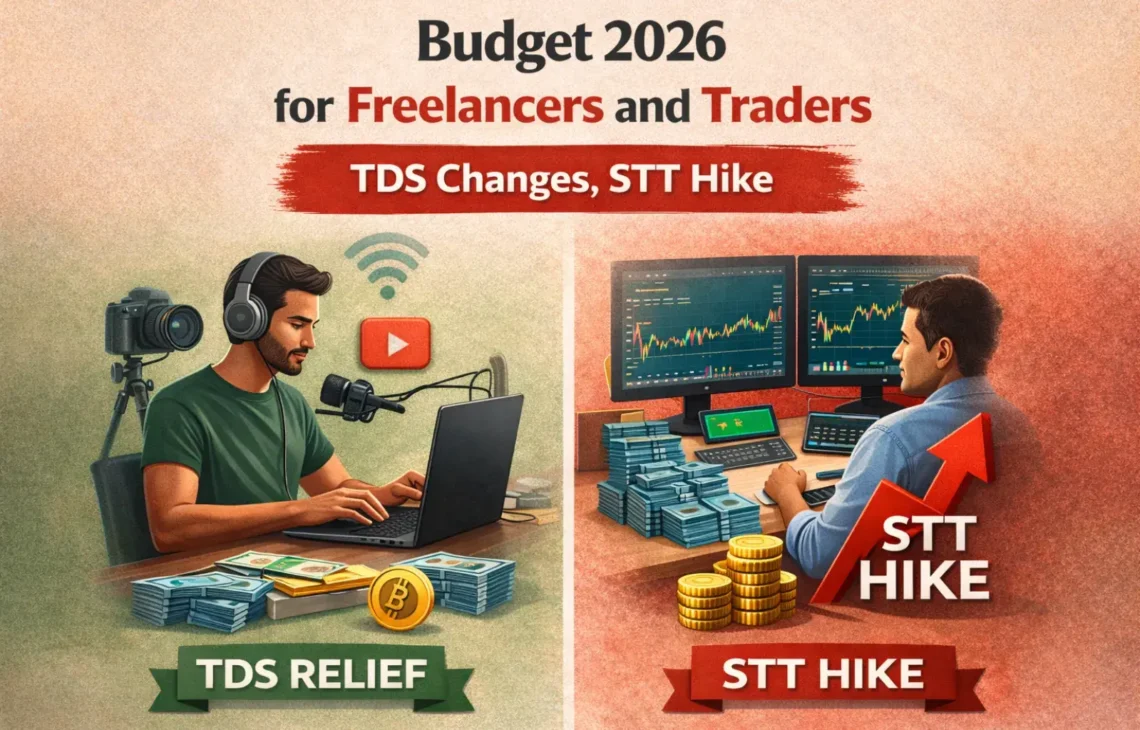
The Union Budget 2026 isn’t just a document for billionaires; it is a roadmap for the millions of Indians earning through laptops, smartphones, and trading terminals. If you are a freelancer, a YouTuber, a crypto enthusiast, or a part-time options trader, the Finance Minister has just rewritten your rulebook.
Budget 2026 for Freelancers and Traders: What’s New
For a newcomer, the technical jargon can be overwhelming. Let’s break down the complex world of Budget 2026 into simple, actionable insights.
1. The Trading Shock: Understanding the STT Hike
If you make money by buying and selling stocks in the “Futures & Options” (F&O) segment, your cost of doing business just went up.
- What is STT? Securities Transaction Tax is a direct tax levied on every purchase and sale of equities.
- The 2026 Change: The government has increased the STT on F&O trades by a significant margin.
- The Impact: For a beginner, this means your “Break-even” point is now higher. You need to make a bigger profit just to cover the taxes. This move is designed to discourage high-risk retail gambling and promote long-term investing.
- Expert Advice: If you are a small trader, focus on “Quality over Quantity.” High-frequency trading will now burn a larger hole in your pocket due to cumulative STT.
2. The Freelancer’s Win: New TDS & Presumptive Taxation
For those in the Make Money Online sector (Freelancers, Content Creators, Consultants), the budget brings a mix of compliance and relief.
- TDS Simplified: Tax Deducted at Source (TDS) is the small portion of your payment that a client cuts before paying you. In 2026, the government has rationalized TDS rates for many online services from 2% down to 1% in specific categories.
- Cash Flow Benefit: This is huge for beginners. Less tax deducted at the start means more “Cash in Hand” to reinvest in your gear (like those cheaper laptops we discussed in our previous guide!).
- Section 44ADA (The Secret Weapon): The budget continues to support the presumptive taxation scheme. If you earn under ₹75 Lakhs (subject to certain conditions), you can simply declare 50% of your income as profit and pay tax only on that half. No need to maintain complex accounting books!
3. The Digital Infrastructure: Why Your “Office” Costs Less
Every digital earner needs two things: High-speed internet and hardware.
- Hardware Relief: As highlighted in our [Budget 2026 Price List], the duty cuts on semiconductor components mean that upgrading your “Digital Shop” (MacBooks, High-end PCs, and Studio Cameras) will be 5-8% cheaper by mid-2026.
- 5G Expansion: The budget has allocated massive funds for rural 5G connectivity. For a freelancer living in a Tier-2 or Tier-3 city, this means more stable connections to international clients.
4. For the Newbie: 3 Terms You MUST Know Now
If you are just starting your “Make Money Online” journey, memorize these:
- Fiscal Deficit: Think of this as the Government’s “Credit Card Bill.” When this is high, taxes usually go up. The 2026 budget aims to keep this low.
- Capital Gains Tax: The tax you pay on the “Profit” you make from selling stocks or crypto. Check the updated slabs before you sell your portfolio this year.
- Direct vs. Indirect Tax: Income tax is Direct (out of your pocket). Custom Duty is Indirect (added to the price of the iPhone you buy). Budget 2026 has played with both.
Expert Analysis: The “Survival” Strategy for 2026
As someone who has tracked markets for 10 years, my advice to digital earners is this: Diversify. The hike in trading taxes (STT) means you shouldn’t rely solely on daily trading. Use the savings from the lower TDS to build a “Freelance Skill” or invest in “Direct Equity” (Long-term stocks), where the tax impact is more manageable. The 2026 Budget clearly favors the “Producer” (Freelancer/Manufacturer) over the “Speculator” (Day Trader).
Read Also: Why India’s Middle Class Feels Betrayed Again: Budget 2026 Analysis
Frequently Asked Questions (For Beginners)
Q1. I am a student making ₹20,000/month from freelancing. Do I need to care?
A: Absolutely. Even if you don’t fall under the tax bracket, the 1% TDS deducted by your clients can be claimed back as a refund if you file your ITR.
Q2. Is Crypto taxation still 30%?
A: Yes, the 2026 Budget has maintained the 30% tax on Virtual Digital Assets (VDAs) and 1% TDS on every trade. The government remains cautious about the crypto market.
Q3. Should I register as a Business or an Individual?
A: With the new 44ADA limits, most freelancers find it easier to stay as “Individuals” to enjoy the 50% profit declaration benefit.